
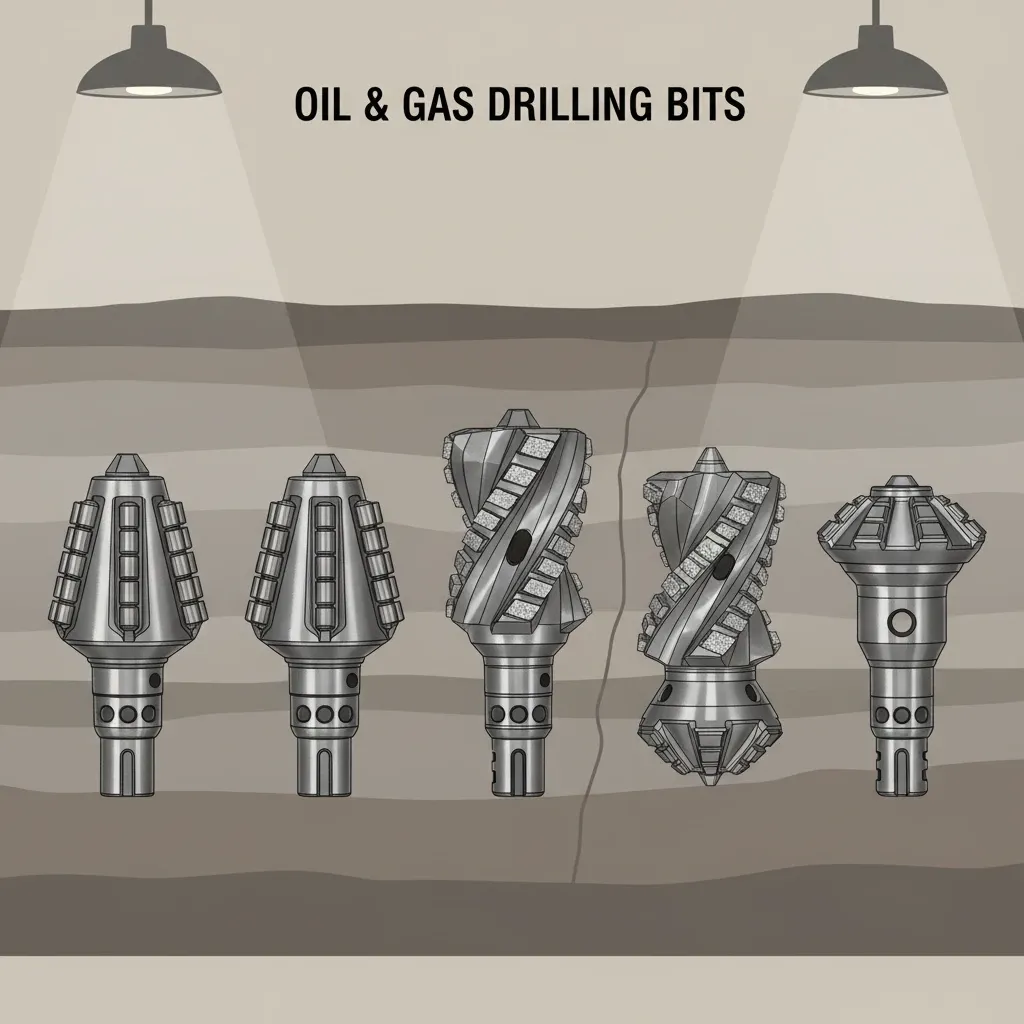
In oil and gas well drilling, the drill bit is the only tool that directly interacts with the formation. For this reason, proper bit selection plays a decisive role in rate of penetration (ROP), equipment lifespan, cost per drilled meter, and overall operational safety. Many drilling challenges—such as excessive vibration, premature wear, well deviation, and non-productive time (NPT)—are directly linked to incorrect bit selection.
This article provides an engineering-based yet practical overview of drill bit types used in the oil and gas industry. It explains the differences between PDC and tricone bits, clarifies the role of IADC codes and dull grading in bit selection, and introduces modern technologies such as at-bit imaging
According to industry-standard drilling references, drill bits are generally divided into two main families:
Roller Cone (Tricone) Bits
Fixed Cutter Bits, primarily including PDC and diamond bits
This classification forms the foundation of drill bit selection in most oil and gas drilling projects.
A tricone drill bit consists of three rotating cones mounted on bearings. The teeth on these cones crush and fracture the formation through applied weight on bit (WOB) and drill string rotation. Tricone bits are still widely used in soft to medium formations and in heterogeneous drilling environments.
Steel Tooth vs. TCI Tricone Bits
Tricone bit teeth are generally designed in two configurations:
Steel Tooth (Milled Tooth): Suitable for soft formations where penetration relies primarily on tooth indentation.
TCI (Tungsten Carbide Insert): Equipped with tungsten carbide buttons, offering higher durability and improved performance in harder and more abrasive formations.
As formation hardness and abrasiveness increase, TCI bits typically become the more appropriate choice. However, final selection should always be validated using performance data and dull condition analysis.
IADC Codes for Tricone Bits
The three-digit IADC code is a standardized system used to describe the primary characteristics of tricone bits. It allows drilling engineers to quickly understand formation hardness range and bit design without reviewing detailed manufacturer catalogs. In practice, IADC codes serve as the starting point for comparing and selecting tricone bits.
Fixed cutter bits have no moving parts and drill by continuously shearing the formation rather than crushing it. The most widely used member of this family is the PDC bit, which now accounts for a significant portion of oil and gas drilling operations worldwide.
What Is a PDC Bit and Why Is It So Widely Used?
PDC bits use synthetic polycrystalline diamond cutters to shear the rock. This cutting mechanism typically delivers higher ROP and more stable drilling behavior across many formations. As a result, PDC bits have become the first-choice solution in many oil and gas fields.
Steel Body vs. Matrix Body PDC Bits
PDC bits are commonly manufactured with two body types:
Steel Body: Higher toughness and improved repairability
Matrix Body: Superior abrasion resistance in highly abrasive formations
The selection between steel and matrix bodies depends on formation characteristics, impact risk, repair strategy, and overall project economics.
Hybrid drill bits are designed for formations where neither tricone nor PDC bits perform optimally on their own. These bits integrate features of both families and are commonly applied in heterogeneous, interbedded formations or in environments prone to drilling vibrations. Their primary objective is to enhance stability and reduce drilling dysfunctions.
Drill bit selection should never be based solely on brand preference or limited experience. A logical and data-driven selection workflow typically includes:
Formation characterization (hardness, abrasiveness, lithology)
Evaluation of operational constraints (WOB, RPM, hydraulics, well trajectory)
Selection of the appropriate bit family (Tricone, PDC, or Hybrid)
Review of historical offset well performance data
Use of dull grading reports to refine the final selection
In recent years, the drilling industry has increasingly shifted toward data-driven decision-making. One notable advancement is at-bit imaging, which captures formation data directly near the bit. The Retina™ technology introduced by SLB is a prime example, converting cutter force data into high-resolution borehole images. These insights significantly improve formation understanding and real-time drilling decisions.
What is a PDC drill bit and why is it widely used in oil and gas drilling?
A PDC bit is a fixed cutter bit that shears the formation, delivering higher ROP and stable performance, making it a preferred choice in many fields.
What is the main difference between PDC and tricone drill bits?
PDC bits cut the rock through continuous shearing, while tricone bits rely on crushing and fracturing using rotating cones.
What is the purpose of the IADC drill bit code?
The IADC code is a standardized classification system that describes general bit design and target formation characteristics, enabling faster and more accurate selection
What is dull grading and why is it important?
Dull grading documents bit wear and damage after drilling and plays a critical role in optimizing future bit selection and drilling performance.
When are hybrid drill bits recommended?
Hybrid bits are recommended in heterogeneous formations where neither PDC nor tricone bits alone provide stable and efficient performance