
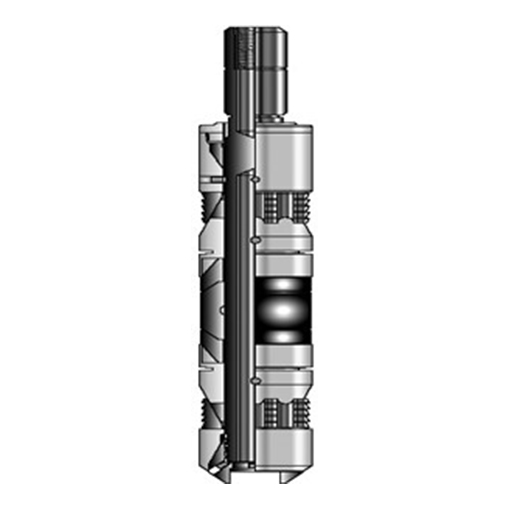
Composite Bridge Plug
The Composite Bridge Plug designed to provide an economical means of isolating casing while facilitating a very short drill time to remove the plugs after the job. These series of composite plugs are rated to 10,000 psi at 250 degrees Fahrenheit. A wide size range is readily available.
The plug sleek, and lightweight (only 17lbs.) design makes deployment fast and efficient in both vertical and horizontal wells. With consistent drill times of 15 minutes or less, the Plug will help you maximize operational efficiency and increase overall well reservoir economics.
FEATURES
BENEFITS
- The plug’s bottom is slotted to prevent spinning during drilling operations.
- Various sizes, pressure and temperature ratings available.
- Can be set on Wireline, coiled tubing or production tubing.
- Multiple plugs in a single wellbore.
- Extremely fast milling and drilling operation.
- High differential pressure ratings.
APPLICATIONS
- Used for temporary isolation in multi-stage vertical or horizontal completion operations.
- Utilizes retrievable packer style sealing elements.
- Provides absolute zone isolation during multi-zone hydraulic fracturing.
- Drill over can be accomplished using conventional junk bits or tri cone bit.
- Can be ran and set through acid.
- Available in slim hole sizes.
K1 Cement Retainer
EZ Drill SVB Squeeze Packer
Wireline Set Bridge Plug (WL-BP)

TM-IRPP Inflatable Retrievable Production Packer (پکر قابل بازیافت بادی)

Composite Bridge Plug Technology in Oil and Gas Completions
The Composite Bridge Plug represents a significant evolution in downhole isolation technology. Designed to provide an economical and reliable means of isolating casing intervals, these plugs facilitate zonal isolation during multi-stage stimulation while ensuring a rapid removal process.
Modern unconventional reservoirs require efficient “Plug and Perf” operations. The Composite Bridge Plug answers this need by combining high-pressure ratings (up to 10,000 psi) with materials that can be milled out in minutes, maximizing operational efficiency and accelerating time-to-production.
Overview of Composite Bridge Plug Design
A Composite Bridge Plug is a downhole tool used to isolate the lower part of a wellbore from the upper section. Unlike traditional cast iron plugs, composite plugs are manufactured from advanced filament-wound epoxy resins and glass fiber materials.
This material selection results in a tool that is significantly lighter than its metal counterparts—often weighing only 17 lbs. The lightweight design not only simplifies logistics and handling on the rig floor but also enhances deployment speed in horizontal wells, where friction can be a limiting factor.
Evolution from Cast Iron to Composite
Historically, cast iron bridge plugs provided robust isolation but were difficult and time-consuming to drill out. The transition to composite bridge plug technology has revolutionized well completions by offering comparable pressure ratings with superior drillability.
Key Features and Engineering Benefits
The engineering behind a Composite Bridge Plug focuses on two main phases: reliable setting (isolation) and efficient removal (mill-out).
Anti-Rotation Mechanism (Slotted Bottom)
One of the most critical features of a high-performance composite plug is the anti-rotation design. The plug’s bottom is specifically slotted or castellated.
- Function: When multiple plugs are set in a wellbore, the top of the lower plug interlocks with the bottom of the upper plug during milling.
- Benefit: This “locking” action prevents the plug from spinning under the drill bit, ensuring efficient torque transfer and reducing mill-out time.
High-Strength Composite Materials
The body consists of high-grade composite materials capable of withstanding extreme downhole environments.
- Pressure Rating: Rated up to 10,000 psi, making them suitable for high-pressure hydraulic fracturing.
- Temperature Stability: Functional at temperatures up to 250 degrees Fahrenheit (and higher in specialized models).
- Drillability: The composite material breaks into small, lightweight cuttings that are easily circulated out of the wellbore by the drilling fluid.
Operational Applications
Multi-Stage Hydraulic Fracturing
The primary application of the Composite Bridge Plug is in multi-zone hydraulic fracturing (fracking).
- The plug is set to isolate a specific zone.
- Perforation guns are fired above the plug.
- Frac fluid is pumped into the new zone while the plug protects the zones below.
This cycle is repeated dozens of times in a single wellbore, necessitating a plug that guarantees absolute zone isolation.
Horizontal and Vertical Integration
Whether in vertical exploration wells or extended-reach horizontal laterals, the composite plug is versatile.
- Vertical Wells: Used for zonal isolation in remedial workovers or acidizing campaigns.
- Horizontal Wells: The lightweight design allows for “pump-down” operations where the plug is conveyed via wireline and pumped into place with fluid.
Deployment and Setting Mechanisms
Flexibility in deployment is a key advantage of the Composite Bridge Plug.
Conveyance Methods
- Wireline: The most common method for “Plug and Perf” operations due to speed and real-time depth correlation.
- Coiled Tubing: Used when pushing the plug into highly deviated wells is necessary.
- Production Tubing: Utilized in specific rig-based completions.
Setting Sequence
The plug utilizes retrievable packer-style sealing elements. Upon activation (via an explosion setting tool or hydraulic pressure), the slips bite into the casing, and the sealing element expands to create a pressure-tight barrier.
Mill-Out and Removal Process
The removal of the Composite Bridge Plug is where its value is most apparent. After stimulation is complete, Coiled Tubing or a Jointed Pipe is run into the hole to mill out the plugs.
Fast Drilling Times
Due to the composite construction and anti-rotation features, consistent drill times of 15 minutes or less per plug are standard. This is significantly faster than the hour-plus times often required for cast iron plugs.
Recommended Milling Tools
As discussed in previous technical documentations regarding milling tools, the selection of the bit is crucial.
- Junk Mills: A bladed junk mill dressed with crushed tungsten carbide is highly effective for composite materials.
- Tri-Cone Bits: Rock bits (tri-cone) can also be used, particularly if hard formations between plugs need to be drilled.
The debris generated is small and has a low specific gravity, allowing the drilling fluid to transport it to the surface effortlessly without forming “bird nests” or clogs in the annulus.