
The effective management and production of hydrocarbons fundamentally rely on maintaining wellbore integrity and optimizing inflow performance over the life of the asset. One of the most persistent operational challenges, particularly in unconsolidated or weakly consolidated sandstone reservoirs, is the production of formation sand along with reservoir fluids. Uncontrolled sand production can lead to a cascade of severe issues, including erosion of downhole and surface equipment, casing collapse, blockages in production tubing, and significant operational downtime for cleanouts. Addressing this challenge requires robust sand control solutions, and among the most advanced of these is the expandable sand screen (ESS). This article provides a detailed engineering overview of ess expandable sand screen, its mechanics, applications, and operational advantages over conventional methods.
What Are Expandable Sand Screens (ESS)?
An expandable sand screen, commonly referred to by the acronym ESS, is a sophisticated downhole filtration device engineered to prevent the migration of formation sand into the wellbore. Unlike conventional sand screens, an ESS is run into the well with an outer diameter smaller than its final set diameter. Once at the target depth, it is mechanically or hydraulically expanded radially outward to contact the inner wall of the open or cased hole. This expansion creates a large-diameter, highly permeable filter that provides structural support to the formation and establishes a reliable barrier against sand ingress, forming the core of modern ESS technology.
Ideal Applications: Casedhole ESS (Expandable Sand Screen) Installations
While expandable sand screens are most commonly associated with open-hole completions, their application in cased-hole environments has gained significant traction as a robust solution for sand control in mature fields, recompletions, and wells with existing casing integrity constraints. Casedhole ESS represents an evolution in sand control philosophy, enabling the benefits of expandable technology to be realized in wells where open-hole deployment is impractical or impossible.
In a cased-hole ESS completion, the screen is installed inside a perforated casing or liner and subsequently expanded to conform either to the inner diameter of the casing or, in advanced designs, to partially penetrate and mechanically engage the perforation tunnels. This configuration allows the ESS to function as a high-integrity sand control and flow distribution system while leveraging the structural support already provided by the casing.
Engineering Drivers for Casedhole ESS Deployment
Casedhole ESS installations are typically selected when specific operational or reservoir constraints limit the applicability of conventional sand control methods:
Mature and Depleted Reservoirs:
In late-life assets, declining reservoir pressure and increasing water cut often exacerbate sand production. Conventional gravel packing in cased holes can be operationally complex and economically unattractive. Casedhole ESS offers a lower-risk alternative with reduced rig time and minimal fluid handling, making it particularly suitable for brownfield developments and workover campaigns.
Recompletion and Zonal Remediation Scenarios:
Wells requiring selective sand control across previously perforated intervals benefit significantly from casedhole ESS. The expandable screen can be precisely positioned across target zones, enabling isolation of problematic sand-producing intervals without the need for extensive cement squeeze or liner installation operations.
Mechanical Integrity and Wellbore Stability Considerations:
In wells where casing deformation, ovality, or localized damage exists, the radial expansion capability of ESS allows the screen to conform to non-uniform internal geometries. This adaptability enhances mechanical stability and ensures continuous contact, reducing the risk of localized high-velocity flow paths that can lead to erosion or premature failure.
Flow Dynamics and Sand Retention Mechanism in Casedhole ESS
Unlike open-hole ESS, where sand retention occurs directly at the formation face, casedhole ESS operates downstream of the perforations. Produced fluids carrying formation fines enter the wellbore through the perforation tunnels before encountering the expandable screen. The filtration jacket is therefore designed to handle higher localized velocities and a broader particle size distribution.
The elimination or minimization of the annular gap between the expanded screen and the casing is a critical performance factor. By expanding the screen to near-casing ID, casedhole ESS reduces annular flow, forces uniform inflow through the filtration media, and mitigates the risk of sand settling and accumulation between the screen and casing—a common failure mechanism in conventional cased-hole screens.
Advantages of Casedhole ESS over Conventional Casedhole Sand Control
From a comparative engineering standpoint, casedhole ESS offers several distinct advantages over traditional wire-wrapped screens, slotted liners, or cased-hole gravel packs:
- Reduced Completion Complexity: Gravel packing in cased holes requires precise slurry placement and effective perforation coverage. ESS deployment is predominantly mechanical, significantly reducing operational uncertainty.
- Lower Skin and Improved Inflow Efficiency: The large effective flow area of the expanded screen minimizes pressure drop across the sand control system, which is particularly critical in low-pressure or marginal wells.
- Enhanced Longevity and Erosion Resistance: Uniform inflow distribution across the screen length reduces localized erosion at perforation clusters, extending completion life.
- Compatibility with Intelligent and Smart Well Systems: Casedhole ESS can be seamlessly integrated with inflow control devices (ICDs) and zonal isolation hardware, supporting advanced production management strategies in complex reservoirs.
The Critical Need for Effective Sand Control Solutions in Well Productivity and Longevity
The primary objective of any sand control completion is to maximize hydrocarbon production without compromising the integrity of the well or surface facilities. Ineffective sand control directly impacts a well’s profitability and operational lifespan. The consequences extend beyond simple blockages; fine particles can plug gravel packs, damage Electrical Submersible Pumps (ESPs), and create significant surface handling and disposal costs. Therefore, the selection and implementation of the correct sand control method is a critical decision in well completion services. This decision directly influences the well’s productivity index (PI) and ultimate recovery factor, making the evaluation of technologies like ESS essential for well productivity optimization.
Core Mechanics and Design of ESS Technology
Understanding the operational superiority of ESS requires a detailed examination of its components and the expansion process. The design is a synergy of metallurgy, filtration science, and mechanical engineering.
Deconstructing the Solid Expandable Sand Screen Mechanism
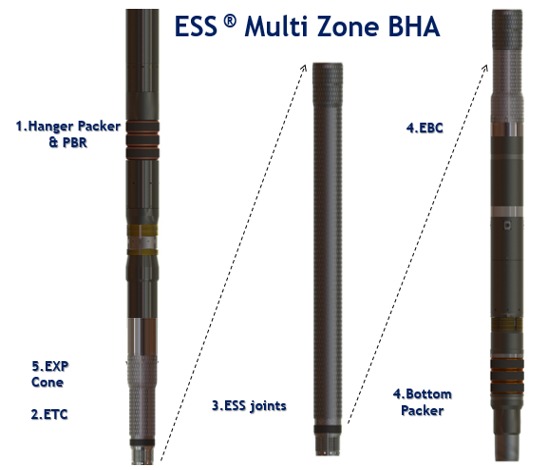
The solid expandable sand screen mechanism is not monolithic; it is an assembly of precision-engineered components, each with a specific function:
- Base Pipe: This is the structural backbone of the screen. It is perforated or slotted and manufactured from a ductile alloy designed to undergo plastic deformation without fracturing. Its unique geometry enables it to expand radially to a predetermined diameter. Material selection (e.g., 316L stainless steel, 13Cr, or higher-grade corrosion-resistant alloys) is critical and based on the well’s chemical environment.
- Filtration Jacket: This multi-layered assembly is the core sand-control component, typically diffusion-bonded to the base pipe. It consists of an inner drainage layer for flow distribution, the primary filtration media (often a precision-woven wire mesh, such as a Dutch twill weave, optimized for the specific formation sand size), and an outer layer. The pore throat opening of the filter media is meticulously designed based on the formation’s particle size distribution (PSD) analysis to ensure effective sand retention while minimizing drawdown pressure.
- Protective Outer Shroud: This robust, perforated outer layer provides essential mechanical protection to the delicate filter media during deployment through the wellbore and across challenging intervals. It is engineered to withstand high torque and drag forces while ensuring unrestricted inflow once the well is in production.
- End Rings: These components are welded at the ends of each screen joint, providing structural integrity and a seal point for the expansion process, ensuring uniform deformation along the length of the screen.
The Expansion Process: From Deployment to Annular Conformance
The transformation from a run-in configuration to a fully set screen is the defining feature of the ESS deployment procedure. This process is typically achieved using a high-pressure hydraulic expansion cone or a compliant mechanical tool run on a workstring.
- Deployment: The ESS assembly is run to the target depth. Its smaller run-in outer diameter provides significant annular clearance, simplifying deployment and reducing the risk of getting stuck, especially in highly deviated or long horizontal wells.
- Expansion Initiation: The expansion cone or tool is positioned at the bottom-most section of the ESS assembly. Hydraulic pressure is applied through the workstring, which forces the cone through the screen’s inner diameter.
- Controlled Expansion: As the cone travels through the screen, its tapered profile applies a uniform radial force, plastically deforming the base pipe and filtration jacket outwards. This is a precisely controlled mechanical process, and the surface pressures and string weight are monitored in real-time to verify correct expansion. The expansion ratio, the ratio of the final outer diameter to the initial outer diameter, is a key design parameter.
- Final Conformance: The screen is expanded until it makes firm, continuous contact with the borehole wall. This direct contact eliminates the annulus, which is a key factor in annular flow improvement, preventing fluid bypass and providing direct mechanical support to the formation face.
Operational Advantages: Expandable Sand Screen vs Gravel Pack and Other Conventional Methods
The decision to utilize ESS is often made after a rigorous technical and economic comparison against traditional sand control techniques, most notably open-hole gravel packs (OHGP).
A Comparative Analysis: ESS vs. Conventional Gravel Pack
The technical debate over expandable sand screen vs gravel pack centers on three core areas: reservoir integrity, operational efficiency, and long-term reliability.
- Formation Damage and Skin Factor: A primary advantage of ESS is the significant reduction in potential formation damage. Gravel packing is a fluid-intensive operation, requiring the pumping of carrier fluids and gravel slurry at high rates. These fluids can invade the near-wellbore formation, interact with clays, and alter wettability, ultimately impairing permeability and creating a positive skin factor. In contrast, expandable sand screen installation is essentially a “pump-free” mechanical process, minimizing fluid loss to the formation and preserving its native permeability.
- Operational Risk and Efficiency: Executing a successful OHGP, especially in a long horizontal well, is a complex and high-risk operation. Challenges include incomplete packing (leading to voids), premature screen-out, and significant fluid loss control issues. These operations are time-consuming and require extensive logistical support. The deployment of ESS is a comparatively simpler, faster, and more predictable mechanical operation, significantly reducing rig time and associated operational risks.
- Annular Flow and Wellbore Stability: In a gravel pack, the annulus between the screen and the borehole is a critical component that can also be a failure point. An incomplete pack can create flow channels, leading to screen erosion and failure. By expanding to contact the wellbore directly, ESS eliminates this annulus, improving wellbore stability by providing direct mechanical support to the formation and ensuring all flow is directed through the filter media.
Key Benefits of ESS in Well Completion
The technical advantages of ESS translate into tangible performance gains. The key benefits of ESS in well completion include:
- Maximized Internal Diameter (ID): Post-expansion, the ESS provides a much larger ID compared to a conventional screen and gravel pack assembly. This “big bore” completion reduces flow velocity, minimizes frictional pressure losses, and increases the well’s production potential. It also provides better access for future well interventions.
- Enhanced Formation Damage Prevention: By avoiding the need for pumping large volumes of completion fluids, ESS completions protect the reservoir from damage, leading to lower skin values and higher well productivity from day one.
- Superior Performance in Horizontal Wells: ESS technology mitigates the inherent challenges of gravel placement in long, undulating laterals, ensuring a reliable and uniform sand control solution along the entire reservoir section.
Applications and Technical Selection Criteria for ESS
The versatility of ESS allows for its deployment in a wide range of new drill and workover scenarios.
Ideal Applications: Open Hole Expandable Sand Screen Installations
The most prevalent and impactful application is in open hole expandable sand screen completions. This approach is particularly effective in:
- Long horizontal and extended-reach drilling (ERD) wells where achieving a complete gravel pack is logistically difficult or impossible.
- Unconsolidated formations that require mechanical support to prevent borehole collapse.
- Reservoirs with high permeability where minimizing skin damage is paramount to maximizing production.
- Standalone completions where a simplified, robust sand control solution is preferred.
Remedial Operations: Cased Hole Sand Screen Repair and Recompletions
ESS technology provides unique solutions for well remediation. In wells with failed gravel packs or damaged conventional screens, a smaller-diameter ESS can be run through the existing completion tubing and expanded inside the old screen. This cased hole sand screen repair technique, known as a clad or patch, effectively isolates the damaged section and restores sand control without a costly workover, salvaging production from a compromised well.
The Expandable Sand Screen Installation and Deployment Procedure
A successful installation is a methodical, three-phase process that relies on precision engineering and strict adherence to operational best practices.
Phase 1: Pre-Job Engineering and Wellbore Preparation
This phase involves detailed planning, compatibility checks, and running procedure simulations. A critical operational step is thorough wellbore cleanup. The open hole section must be meticulously cleaned of drilling mud, residual filter cake, and debris using mechanical scrapers and specialized chemical washes. This ensures the screen can expand properly against a clean formation face and that inflow is not impeded.
Phase 2: A Step-by-Step ESS Deployment Procedure
The core of the expandable sand screen installation involves the following sequence:
- The ESS joints are made up as part of the lower completion string and run in the hole to the target depth on a workstring.
- The expansion tool assembly is positioned at the bottom of the screen interval.
- Hydraulic pressure is applied to the workstring, actuating the tool and initiating the expansion process from the bottom up.
- Expansion pressures, flow rates, and string weight are closely monitored in real-time at the surface to confirm the screen is expanding correctly and to diagnose any potential borehole irregularities.
- After the entire sand-face interval has been expanded, the expansion tool is disengaged from the screen assembly and retrieved from the well.
Phase 3: Post-Installation Integrity Testing and Well Startup
After the expansion tool is retrieved, the completion’s integrity is verified. This typically involves pressure testing the liner top packer and may include an inflow test to confirm the screen is functioning as designed. The well is then brought online following a carefully managed startup procedure to properly set the filter cake on the screen face and establish stable, sand-free production.
Partnering with Hamrah Pooshesh for Advanced Completions
The continuous drive for efficiency and production optimization in the oil and gas industry demands advanced technological solutions. Expandable sand screens represent a proven, reliable method for robust sand control, particularly in complex well architectures. They minimize formation damage, reduce operational risk, and ultimately enhance the value of the asset.
The successful deployment of sophisticated completion technologies like ESS begins with a precisely drilled wellbore. At Hamrah Pooshesh Engineering Services, our core expertise in Directional Drilling and LWD/MWD ensures that the well path is placed exactly as planned, creating the optimal foundation for these advanced completions. Our integrated approach guarantees that from the drill bit to the final completion, every operational phase is engineered for maximum performance. Partner with us to leverage cutting-edge technology backed by unparalleled operational excellence.