
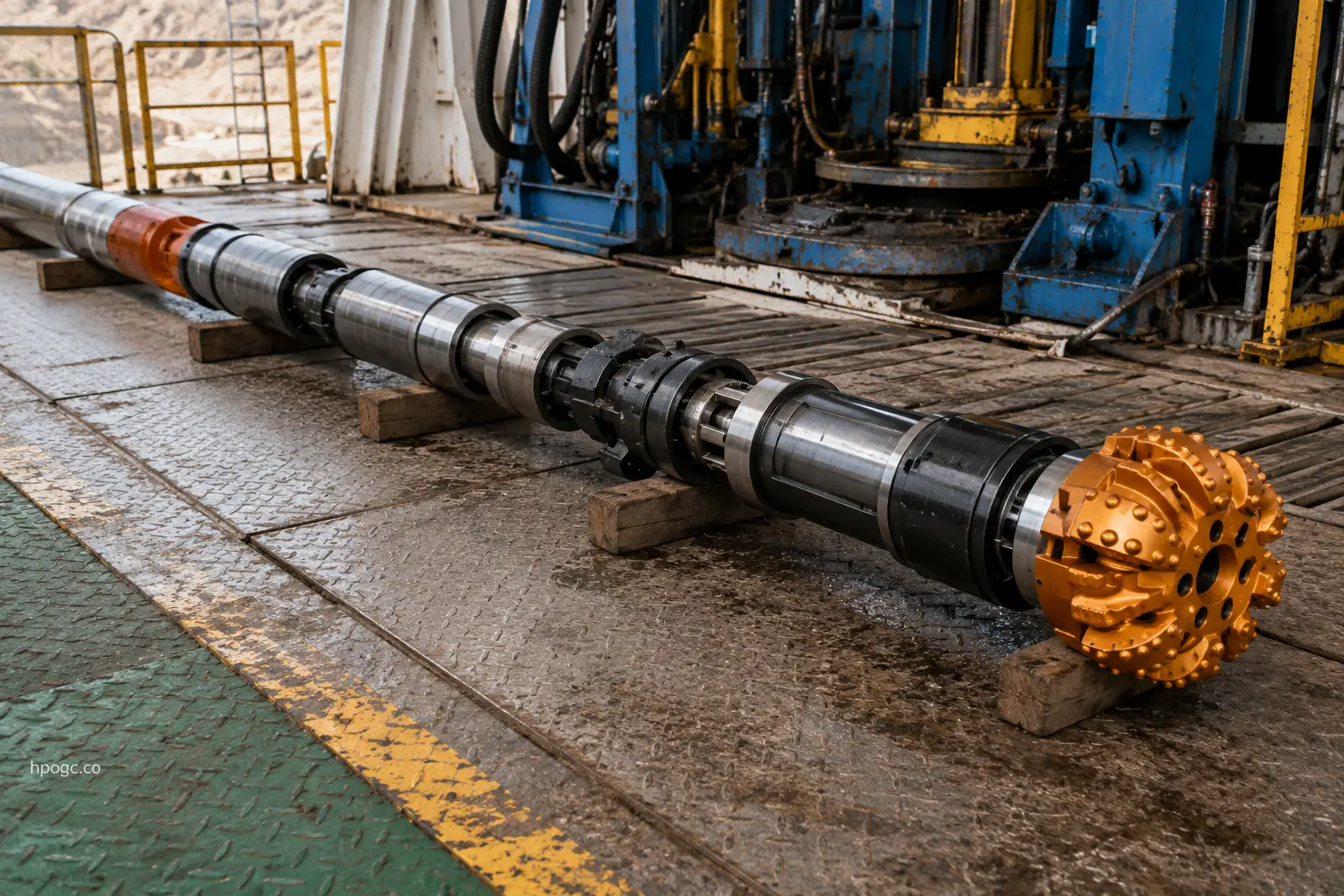
Directional drilling has become one of the most critical technologies in the oil and gas industry, enabling operators to access specific reservoir zones that are difficult—or even impossible—to reach through conventional vertical drilling. Among the key technologies that make directional drilling possible, Downhole Motors (Mud Motors) play a vital role in controlling well trajectory, increasing the Rate of Penetration (ROP), and improving drilling accuracy.
This article examines the operating principles, types, components, advantages, and limitations of downhole motors in directional drilling, with particular emphasis on the operational conditions encountered in Iranian oil and gas fields.
Directional Drilling and the Need for Downhole Motors
What Is Directional Drilling and How Does It Differ from Vertical Drilling?
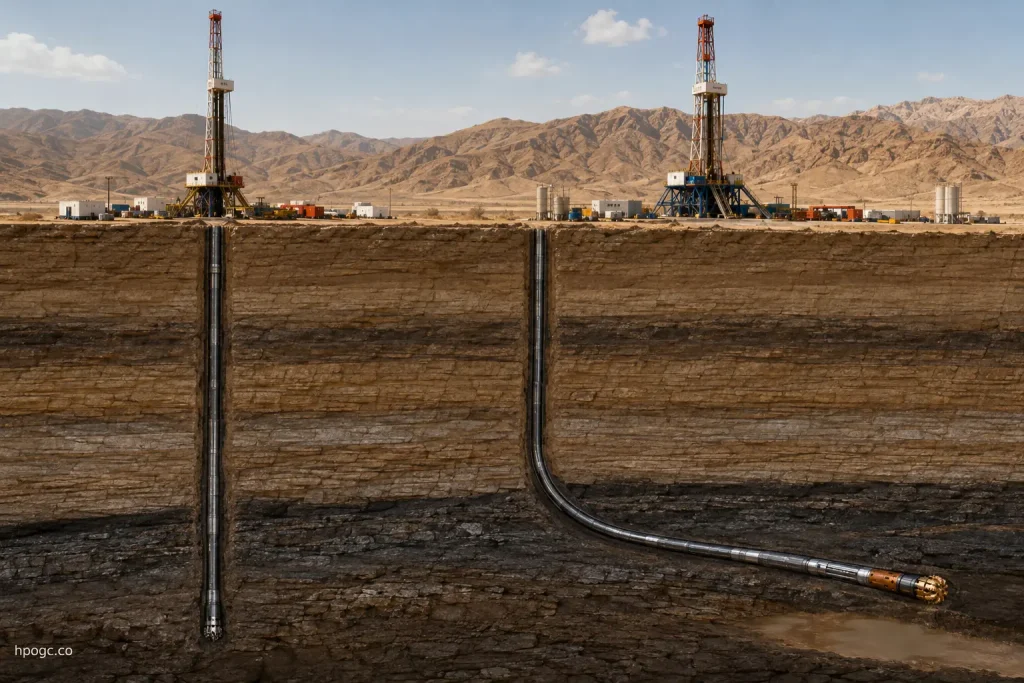
Directional drilling is a drilling process in which the wellbore path is intentionally planned and controlled in terms of inclination and azimuth rather than following a purely vertical trajectory. Unlike conventional vertical drilling, directional drilling enables the construction of horizontal wells, multilateral wells, and extended reach drilling (ERD) wells.
The primary objectives of directional drilling include:
- Increasing reservoir contact area
- Avoiding subsurface obstacles
- Accessing multiple production zones from a single well
- Optimizing hydrocarbon recovery
Why Are Downhole Motors Essential in Directional Drilling?
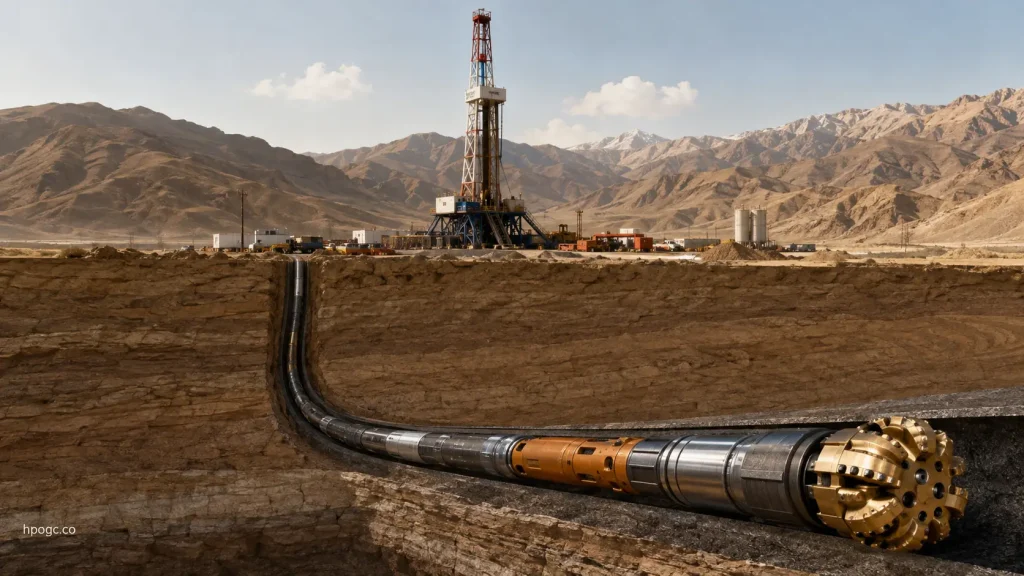
Downhole motors generate torque and rotational movement directly at the bottom of the drill string without requiring rotation of the entire string from the surface. When wellbore deviation or trajectory steering is required, a downhole motor creates a controlled bend and applies localized steering forces at the drill bit.
Compared to surface-driven rotation through a rotary table or top drive system, downhole motors offer better control of dogleg severity and significantly improve directional accuracy.
What Are Downhole Motors?
Definition and Operating Principles
A downhole motor is a hydromechanical tool that converts the hydraulic energy of drilling fluid into mechanical rotational energy. In a typical mud motor, this energy conversion occurs in the power section, which consists of a rotor and stator assembly.
As drilling mud flows through the power section, it causes the rotor to rotate, transmitting torque through the drive shaft to the drill bit. This allows sufficient RPM and torque to be generated at the bit without rotating the entire drill string.
Types of Downhole Motors Used in Oil and Gas Drilling
Mud Motors (Positive Displacement Motors)
Mud Motors, also known as Positive Displacement Motors (PDMs), are the most widely used downhole motors in directional drilling operations.
They consist of:
- A metallic rotor
- An elastomer-lined stator
As drilling fluid passes through the motor, continuous rotational motion is generated. Their primary advantage is the ability to produce high torque at relatively low RPM, making them highly effective in hard rock formations.
Down-The-Hole (DTH) Motors
Down-The-Hole (DTH) Motors
DTH motors are more commonly used in mining and geotechnical drilling applications. Unlike mud motors, they operate using direct percussive impact mechanisms.
While DTH systems have limited applications in onshore oil and gas operations, they remain valuable for specialized drilling environments.
Rotary Steerable Systems (RSS) and Their Relationship with Downhole Motors
Rotary Steerable Systems (RSS) provide active steering capabilities while allowing continuous rotation of the entire drill string.
Unlike mud motors, which typically perform directional control during sliding or low-speed rotation, RSS enables precise trajectory control during full-string rotation.
The choice between Mud Motors, RSS, or a combination of both depends on:
- Well length
- Trajectory complexity
- Required directional accuracy
- Project budget
Main Components of Downhole Motors and Their Relationship with the BHA
Key Components of a Mud Motor
Power Section (Rotor and Stator)
The power section serves as the motor’s energy conversion unit. The design and materials of the rotor and stator determine the motor’s torque output, rotational speed, efficiency, and service life.
Transmission / Drive Shaft
The drive shaft transfers torque from the power section to the drill bit and must withstand substantial axial and lateral loads during drilling operations.
Bearing Section
The bearing section supports axial and radial loads while transmitting torque to the bit. Bearing failure is one of the most common causes of mud motor malfunction.
Bend Housing and Angle Adjustment Mechanisms
The bend housing introduces a predetermined angle into the Bottom Hole Assembly (BHA), enabling directional control when the drill string is not rotating.
The Position of Downhole Motors Within the Directional Drilling BHA
Relationship Between the Motor and Drill Bit
The drill bit selection—whether PDC, tricone, or another type—must be compatible with the motor’s torque and RPM characteristics to achieve optimal drilling performance and ROP.
Integration with MWD and LWD Tools
Measurement While Drilling (MWD) and Logging While Drilling (LWD) tools provide real-time data such as:
- Inclination
- Azimuth
- Gamma ray measurements
- Petrophysical information
These data streams are critical for trajectory correction and geosteering operations.
Impact of BHA Design on Motor Performance
A properly designed BHA incorporates stabilizers, drill collars, and motor placement to achieve desired build, hold, or drop rates while maintaining directional stability.
The Role of Downhole Motors in Well Trajectory and Inclination Control
Build, Hold, and Drop Operations Using Downhole Motors
By utilizing an adjustable bend angle, mud motors enable:
- Build operations (increasing inclination)
- Hold operations (maintaining inclination)
- Drop operations (reducing inclination)
Key parameters influencing trajectory control include:
- Bend angle
- Weight on Bit (WOB)
- Motor RPM
- Drilling fluid flow rate
Proper optimization of these parameters helps maintain acceptable dogleg severity and minimizes unintended deviation.
Critical Operational Parameters
- Dogleg Severity
Dogleg severity measures the rate of directional change in the wellbore and is a key indicator of trajectory control efficiency.
- Weight on Bit (WOB)
Increasing WOB generally improves ROP and may also influence directional response.
- RPM
Higher RPM can alter bit stability and affect steering behavior.
- Drilling Fluid Flow Rate
Flow rate directly impacts motor performance, hydraulic efficiency, bit cleaning, and cooling effectiveness
Improving Reservoir Target Accuracy
Combining mud motor steering capabilities with real-time MWD/LWD data enables drilling teams to continuously adjust the well trajectory and accurately reach target reservoir zones.
This capability is especially important in:
- Extended reach drilling (ERD)
- Horizontal wells
- Multilateral well projects

Advantages of Using Downhole Motors in Directional Drilling
Increased Rate of Penetration (ROP)
Downhole motors deliver high torque at low RPM, making them highly effective when drilling hard formations with PDC bits. This often results in faster drilling and reduced total well construction time.
Reduced Drill String Wear and Mechanical Issues
Because the entire drill string does not need to rotate continuously, common drilling problems such as:
- Stick-slip
- Torque and drag
- Excessive vibration
can be significantly reduced, extending tool life and lowering maintenance costs
Enhanced Trajectory Control and Well Placement Accuracy
Downhole motors improve directional control and increase the likelihood of accurately reaching reservoir targets, making them particularly valuable in complex field developments and horizontal drilling operations.
Challenges and Limitations of Downhole Motors in Iranian Oil Fields
Operational Constraints in Iranian Formations
Iranian oil and gas fields often present challenging drilling environments characterized by:
- High temperatures
- High pressures
- Abrasive formations
- Unstable geological zones
These conditions can negatively impact motor performance and reduce component lifespan.
Elastomer stators are particularly sensitive to elevated temperatures. In HT/HP wells, specialized high-temperature stators are required, increasing operational costs.
Sand-rich and silica-rich formations accelerate wear on both stator and rotor components. Proper drilling fluid design and solids control become critical for maintaining motor reliability.
Maintenance Challenges and Repair Costs
Repairing or replacing the power section and bearing section can be costly. Motor longevity is heavily influenced by drilling fluid quality and operational practices.
Economic Comparison: Downhole Motors vs. RSS in Iranian Projects
Although RSS systems provide greater steering precision and allow continuous drill string rotation, they involve higher costs and greater technological complexity.
For shorter wells and cost-sensitive projects, mud motors often remain the most economical and practical solution. The final selection should be based on:
- Well profile
- Accuracy requirements
- Budget constraints
Selection, Design, and Optimization of Downhole Motors
Technical Selection Criteria
Selecting the appropriate downhole motor requires consideration of:
- Well depth
- Target inclination and azimuth
- Formation characteristics
- Bottomhole temperature
- Pressure conditions
- Rig and pumping capabilities
Operators must also determine whether the primary objective is maximizing ROP or achieving precise trajectory control.
High-angle and extended reach wells often require specialized motor designs and, in some cases, integration with RSS technology.
Formation Type and Rock Mechanics
Soft formations require different bit and motor configurations than hard, abrasive formations.
BHA Design Focused on Downhole Motor Performance
Motor length, stabilizer placement, and MWD positioning should be optimized to maximize steerability and directional performance.
The choice between:
- High-speed motors
- High-torque motors
should be based on formation characteristics and drilling objectives.
Optimization of Drilling Parameters
Real-time monitoring of:
- WOB
- RPM
- Flow rate
- MWD data
allows drilling engineers to continuously optimize motor performance and prevent excessive dogleg severity.
Implementing operational guidelines and control algorithms also contributes to extending motor service life.
The Importance of Engineering Services and Specialized Teams
The Role of Directional Drilling Engineering Teams
Successful directional drilling projects require collaboration among specialists in:
- BHA design
- Geosteering
- Field operations
- Drilling optimization
Experienced teams can interpret real-time data and adjust drilling parameters to maximize performance and minimize risk.
Engineering Support Services for Downhole Motor Operations
Hamrah Pooshesh Engineering Services Company provides comprehensive support for directional drilling projects in Iran, including:
- BHA design
- Mud motor supply and rental
- Real-time monitoring services
- Directional drilling engineering
- Performance analysis
- Technical reporting
These services help operators optimize drilling efficiency, reduce costs, and minimize project duration.
The Future of Downhole Motors in Directional Drilling
Emerging Trends in Downhole Motor Design
Recent technological developments focus on:
- Enhanced HT/HP-resistant stators
- Advanced rotor alloys
- Composite materials for bearing systems
- Improved internal motor geometry for greater efficiency
Additionally, the integration of downhole sensors and real-time performance monitoring systems is enabling predictive maintenance and reliability improvements
The Role of Downhole Motors Alongside RSS and Advanced Technologies
Future drilling projects will increasingly utilize hybrid solutions that combine:
- The steering precision of RSS
- The high-torque capabilities of mud motors
Furthermore, digitalization, data analytics, and artificial intelligence are expected to improve decision-making, equipment reliability, and drilling performance.
Downhole motors remain one of the most important tools in directional drilling. By providing localized torque generation and directional control capabilities, they contribute significantly to increased ROP, reduced mechanical complications, and improved well placement accuracy.
Successful directional drilling projects depend on proper motor selection, optimized BHA design, and continuous real-time monitoring. In Iranian oil and gas fields, particular attention must be paid to temperature resistance and abrasion management to maximize equipment lifespan and operational efficiency.
What Is a Downhole Motor in Directional Drilling and What Role Does It Play?
A Downhole Mud Motor is a drilling tool installed near the bottom of the drill string that uses the hydraulic energy of drilling fluid to rotate the drill bit independently of drill pipe rotation. In directional drilling, a downhole motor generates torque and facilitates wellbore angle building and dogleg adjustments, enabling precise trajectory control. This improves target accuracy and enhances the Rate of Penetration (ROP), particularly in complex well profiles.
What Is the Difference Between a Downhole Motor and an RSS System in Directional Drilling?
A downhole motor uses a power section (rotor and stator) combined with a mechanical bend housing to create directional changes while the drill string remains stationary or operates in sliding mode. In contrast, a Rotary Steerable System (RSS) allows continuous steering while the entire drill string rotates.
RSS technology generally provides higher steering precision and smoother wellbore trajectories but comes at a significantly higher cost. Downhole motors, on the other hand, remain a cost-effective and efficient solution for many directional and horizontal drilling projects, particularly in Iranian oil and gas fields.
What Are the Main Advantages of Using Downhole Motors in Directional Drilling?
Downhole motors offer several key benefits in directional drilling operations:
- Higher Rate of Penetration (ROP) due to the generation of high torque at the bit.
- Reduced drill string wear and mechanical stress, minimizing torque and drag as well as stick-slip issues.
- Improved trajectory control, including build, hold, and drop operations, resulting in more accurate well placement.
- Shorter drilling time and lower overall project costs, especially in horizontal and highly deviated wells.
What Factors Affect the Performance and Lifespan of Downhole Motors in Iranian Oil Fields?
The performance and durability of downhole motors in Iranian drilling environments are influenced by several critical factors:
- High-temperature and high-pressure (HT/HP) conditions that can affect elastomer stators.
- Formation characteristics and rock abrasiveness, which accelerate rotor and stator wear.
- Drilling fluid quality and properties, including viscosity, solids content, and mud type.
- Proper BHA design and optimization of operational parameters such as Weight on Bit (WOB), RPM, and drilling fluid flow rate.
Effective management of these factors can significantly extend motor lifespan and reduce operational failures.
How Can the Right Downhole Motor Be Selected and BHA Design Optimized for Directional Drilling?
Selecting the appropriate downhole motor requires evaluating factors such as well depth, target inclination, formation type, expected ROP, reservoir temperature and pressure, as well as rig and pump limitations.
During BHA design, engineers must optimize:
- Motor length
- Motor type (high-torque or high-speed)
- Stabilizer placement
- Drill bit selection
- MWD/LWD tool positioning
The objective is to achieve optimal steerability while maintaining acceptable dogleg severity. Collaboration with experienced directional drilling service providers and engineering teams, such as Hamrah Pooshesh Engineering Services, plays a critical role in selecting the most suitable motor and designing an efficient BHA configuration.