MWD (Measurement While Drilling) is the fundamental technology that enables operators to receive real-time data regarding the trajectory and physical status of a wellbore without ceasing drilling operations. In the high-stakes environment of oil and gas exploration, where rig time is calculated in thousands of dollars per hour, the ability to navigate the drill bit precisely through complex geological formations is not a luxury—it is an operational necessity.
At Hamrah Pooshesh Engineering Services, we recognize that successful directional drilling campaigns rely heavily on the accuracy and reliability of downhole telemetry. As wells become deeper and targets smaller, the margin for error shrinks. This article provides a technical deep-dive into MWD systems, detailing their mechanics, data transmission protocols, and their indispensable role in minimizing Non-Productive Time (NPT).
Understanding MWD Technology: How It Works
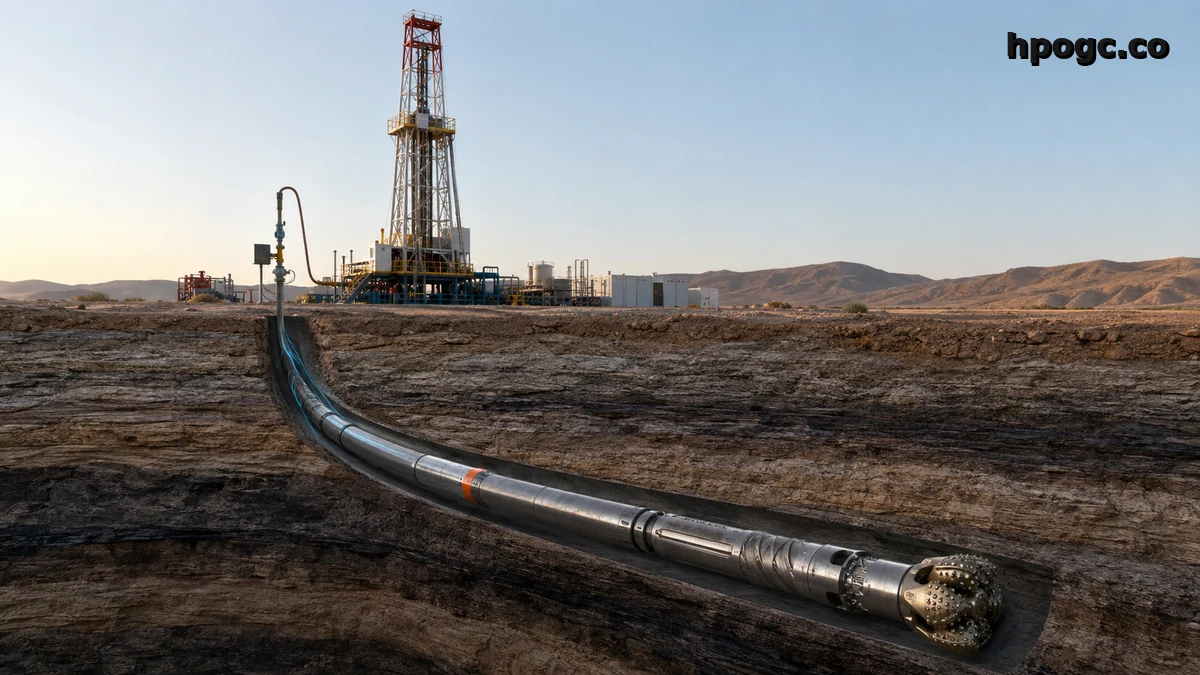
Measurement While Drilling systems are typically housed within a non-magnetic drill collar located in the Bottom Hole Assembly (BHA), positioned immediately above the drill bit or rotary steerable system. The primary function of an MWD tool is to measure the geometric orientation of the wellbore and transmit this data to the surface in near real-time.
An MWD system comprises three integrated subsystems, each engineered to withstand extreme hydrostatic pressures (often exceeding 20,000 psi) and temperatures (up to 175°C or higher).
- Power Supply System:
Downhole electronics require a stable power source. This is achieved through either lithium-thionyl chloride batteries or a turbine-alternator system.
- Batteries: Provide a clean, steady current but have a finite lifespan, limiting the run duration. They are essential when the mud pumps are off (e.g., during connections).
- Turbines: Utilize the flow of drilling fluid to spin an impeller, generating electricity. While this allows for longer downhole duration, it requires mud flow to operate, necessitating a backup capacitor or small battery for survey sequences when pumps are idle.
- Directional Sensor Package:
This is the core of the MWD tool. It typically consists of a tri-axial array of accelerometers and magnetometers.
- Accelerometers: Measure the earth’s gravitational field to determine Inclination (the angle of the wellbore relative to vertical) and Toolface (orientation).
- Magnetometers: Measure the earth’s magnetic field to determine Azimuth (the direction of the wellbore relative to North).
By combining data from these three axes (x, y, z), the system calculates the precise 3D position of the bit.
- Telemetry Unit:
Once data is collected, it must be encoded and transmitted to the surface acquisition system for decoding and analysis by the Directional Driller (DD) and Drilling Engineer.
Data Transmission Methods: Mud Pulse vs. EM Telemetry
The transmission of data from the bit to the surface through thousands of meters of rock and steel is a significant engineering challenge. There are two primary modes of telemetry used in the industry:
1. Mud Pulse Telemetry (MPT)
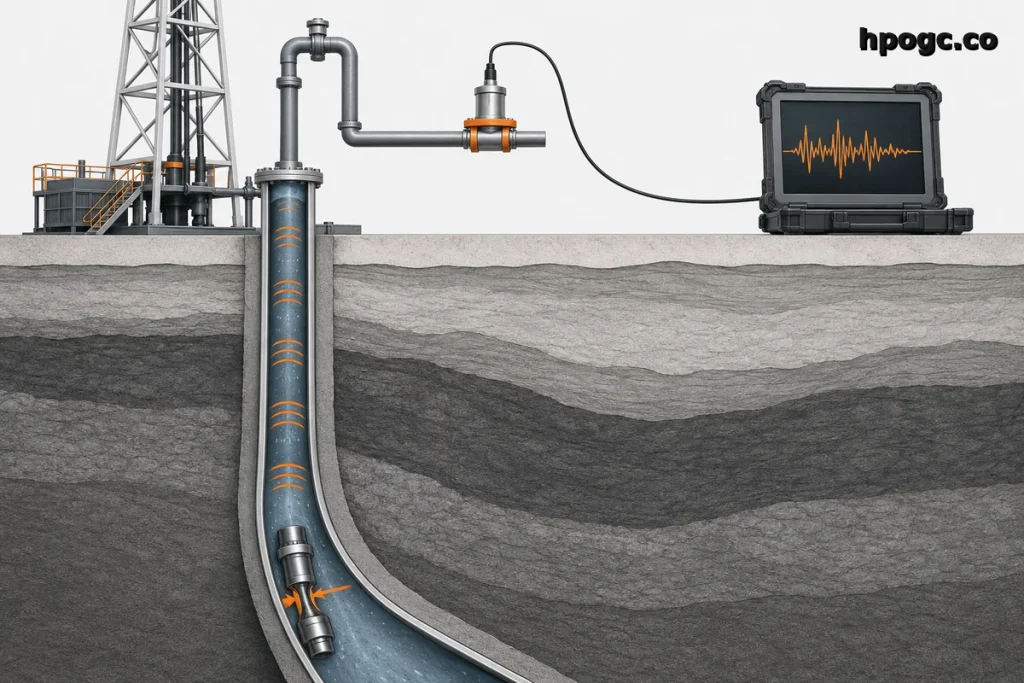
This is the most common method for MWD data transmission. A valve (poppet or shear valve) downhole restricts the flow of drilling fluid, creating pressure fluctuations inside the drill string. These pressure waves travel up the fluid column to the surface, where they are detected by pressure transducers on the standpipe.
- Positive Pulse: A valve momentarily restricts flow, creating a pressure increase (pulse). It is highly robust and resistant to jamming from debris (LCM).
- Continuous Wave: A rotary valve creates a continuous carrier frequency. Data is encoded by modulating the phase or amplitude. This method offers higher data rates (up to 10-15 bits per second) compared to standard pulse systems but is more mechanically complex.
2. Electromagnetic (EM) Telemetry
EM systems transmit data by injecting an electrical current into the formation. An insulator in the drill string separates the two halves of the BHA, acting as a dipole antenna. The signal propagates through the earth’s crust to the surface, where stakes driven into the ground receive the voltage potential difference.
- Advantages: EM is independent of drilling fluid properties. It works in air drilling, underbalanced drilling, or situations with severe lost circulation where mud pulse is impossible.
- Limitations: Signal attenuation increases significantly with depth and in specific formation types (e.g., highly resistive salt domes or highly conductive layers), limiting its depth range compared to mud pulse.
Key Applications of MWD in Oil Well Drilling
The application of MWD in directional drilling has evolved from simple surveying to complex geosteering and drilling optimization. The data provided by these tools dictates the decision-making process on the rig floor.
Trajectory Control and Geosteering
The primary deliverable of any MWD service is the survey record. To hit a geological target that may be only a few meters thick at a depth of 4,000 meters, the Directional Driller monitors the borehole trajectory continuously.
- Toolface Orientation: When using a steerable mud motor, the “Toolface” data tells the driller exactly which way the bent housing of the motor is pointing.
- Gravity Toolface: Used when the inclination is significant, indicating the “High Side” of the hole.
- Magnetic Toolface: Used in near-vertical sections where gravity reference is weak, orienting the tool relative to North.
This real-time feedback loop allows for “Geosteering”—adjusting the well path in response to geological markers to keep the wellbore within the reservoir’s sweet spot for maximum production exposure.
Collision Avoidance in Congested Fields
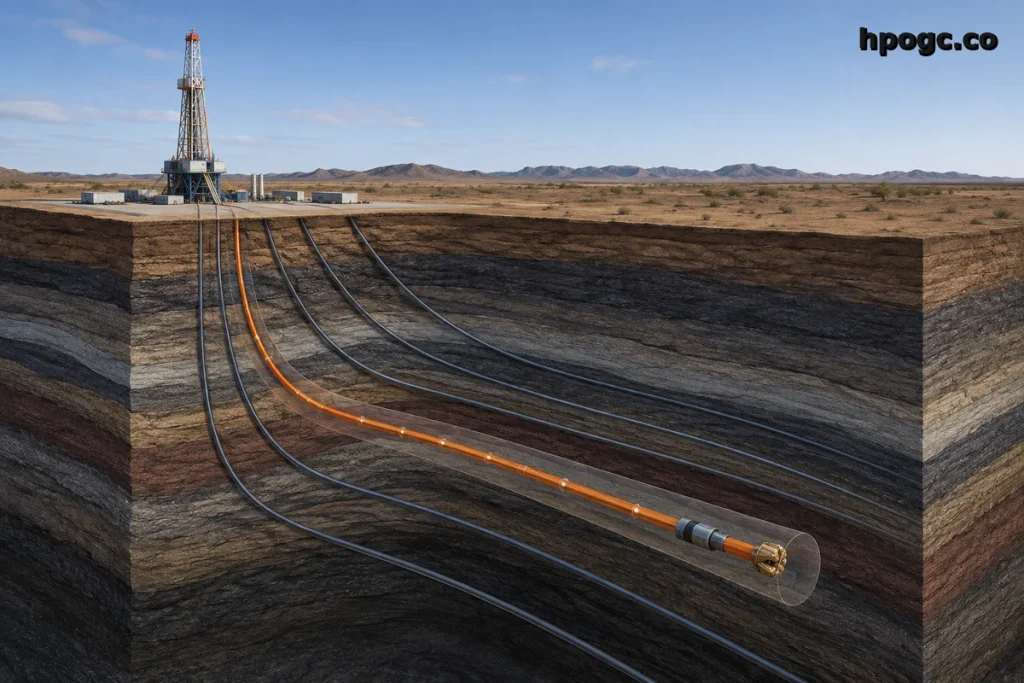
In mature fields or offshore platforms where multiple wells originate from a single pad or template, the subsurface environment is crowded. The risk of intersecting an existing producing well is a major safety hazard that can lead to blowouts or environmental disasters.
MWD provides the coordinate inputs required to calculate the “Ellipse of Uncertainty.” By surveying the well at regular intervals (typically every stand or 30 meters), engineers can plot the current position against the known trajectories of offset wells. If the separation factor drops below the safety threshold, immediate corrective steering actions are taken. This collision avoidance capability is non-negotiable in high-density drilling operations.
Real-Time Drilling Efficiency Optimization
Modern MWD tools do more than navigate; they monitor the health of the drilling process. Downhole sensors are now standard for measuring physical mechanics at the bit:
- Downhole Weight on Bit (DWOB): Surface weight readings are often inaccurate due to friction (drag) along the drill string. MWD sensors measure the actual force applied to the formation, allowing for optimized ROP (Rate of Penetration).
- Downhole Torque: fluctuating torque readings can indicate bit bearing failure or changes in lithology.
- Vibration and Shock: Severe downhole vibrations (axial, lateral, or torsional stick-slip) destroy BHA components and drill bits. MWD tools transmit vibration severity levels to the surface, prompting the driller to adjust RPM or WOB before catastrophic tool failure occurs.
MWD vs. LWD: What is the Difference?
A common point of confusion in the industry, particularly for procurement teams, is the distinction between MWD and LWD. While they are often run in the same BHA and share telemetry, their objectives differ significantly.
Measurement While Drilling (MWD) is strictly navigational and mechanical. It answers the questions:
- Where is the wellbore? (Inclination and Azimuth)
- Where is the tool pointing? (Toolface)
- How is the BHA performing mechanically? (Vibration/Temperature)
Logging While Drilling (LWD) is petrophysical. It answers the questions:
- What formation are we drilling through?
- Is there oil, gas, or water present?
LWD tools utilize complex sensors to measure formation properties such as Gamma Ray, Resistivity, Density, Neutron Porosity, and Sonic velocity. Hamrah Pooshesh Engineering Services frequently deploys integrated MWD/LWD suites, where the MWD tool acts as the “bus,” powering the LWD tools and transmitting their heavy data load to the surface via pulse or EM telemetry.
The Business Value: Reducing Non-Productive Time (NPT)
The implementation of robust Measurement While Drilling systems directly correlates to project economics. Before the advent of reliable MWD, operators relied on “Single Shot” wireline surveys. This required stopping rotation, circulating the hole clean, running a wireline tool to the bottom, taking a picture, and pulling out of the hole—a process that could take several hours per survey.
With MWD, surveys are taken during the “connection time” (when adding a new pipe stand) with zero impact on rig operations.
Furthermore, the diagnostic capabilities of MWD prevent costly fishing operations. By detecting stick-slip vibration early, a driller can alter parameters to save the BHA. If a washout (leak) begins in the drill string, pressure sensors in the MWD tool can often detect the anomaly before the string twists off.
In deep-water or complex land operations, avoiding a single “twist-off” or sidetrack operation due to missed targets covers the cost of the MWD service for the entire campaign.
Advanced MWD Solutions by Hamrah Pooshesh
At Hamrah Pooshesh Engineering Services, we do not merely supply tools; we engineer solutions for specific downhole challenges. Our inventory includes advanced MWD configurations tailored for the diverse lithologies found in the region.
Our services include:
- High-Temperature MWD Systems: Engineered for deep gas wells where bottom-hole temperatures exceed 165°C, ensuring data integrity where standard tools fail.
- Retrievable MWD: Systems designed to be fished via wireline in the event of a stuck pipe, saving the operator the replacement cost of the radioactive sources and expensive electronics.
- High-Speed Telemetry: Utilizing advanced compression algorithms to maximize data density, allowing for higher resolution LWD logging without slowing down ROP.
By combining state-of-the-art hardware with experienced field engineers, Hamrah Pooshesh ensures that your well reaches its target safely, efficiently, and precisely.