For many years, Iran’s upstream oil and gas industry was mainly associated with large state-owned companies. However, over the past two decades, private and semi-private companies have taken on a more visible role in field development, drilling, downhole services, well engineering, equipment supply, and specialized upstream operations. Today, when we talk about “non-governmental players in the upstream oil and gas industry,” we are not only referring to E&P companies. The term also includes drilling contractors, well services companies, directional drilling providers, EPC contractors, downhole equipment manufacturers, and companies that support well operations.
This article focuses on the Iranian market and introduces the most important private and semi-private players in the upstream sector. However, not all companies are discussed with the same level of detail. Better-known companies such as Dana Energy, Pasargad Energy Development Company, OIEC, MAPNA, PEDEX, Global Petrotech Kish, North Drilling, SeaLand, WSI, Petro Kariz Omid Kish, Petro Daniel Kish, and Hamrah Pooshesh Engineering Services Company are discussed more prominently. Lesser-known companies are mentioned as part of a complementary list.
What Is the Upstream Oil and Gas Industry?
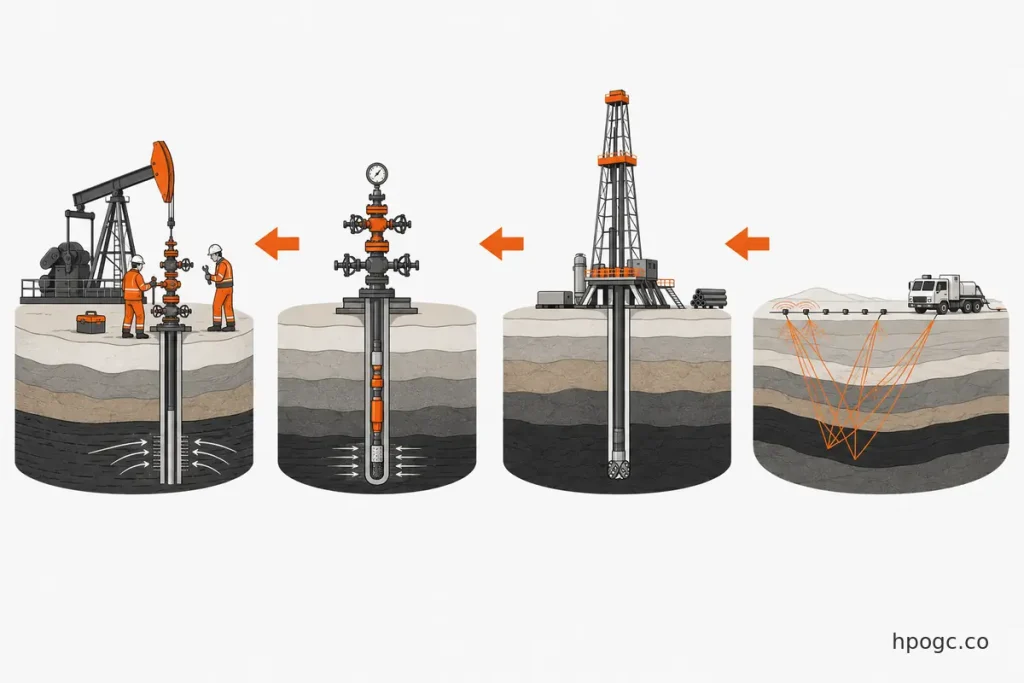
The upstream oil and gas industry refers to all activities that take place before refining, large-scale transportation, and final sales. This part of the industry includes exploration, geological and reservoir studies, seismic surveys, drilling, well completion, well evaluation, early production, downhole services, and production maintenance operations.
In simple terms, any activity directly related to identifying, developing, and producing oil and gas reservoirs can be considered part of the upstream sector. This segment is especially important because technical decisions made in the upstream phase directly affect field development costs, operational safety, production rates, well life, and return on investment.
For example, the selection of the well trajectory, the quality of MWD/LWD data, the design of well completion, the choice of downhole tools, and the reliability of directional drilling services can significantly influence the final performance of a project.
The Difference Between E&P Companies, Oilfield Services Companies, and EPC Contractors
E&P companies, or exploration and production companies, usually operate at the level of field development, reservoir management, production planning, and upstream investment. These companies may act as field operators or work alongside the main client to manage part of the development and production process. The Iranian Association of Exploration and Production Companies also defines its mission around activities related to exploration, development, and production of oil and gas fields.
Oilfield services companies, on the other hand, focus more on specialized operational services. These services may include directional drilling, MWD, LWD, cementing, well testing, slickline, coiled tubing, stimulation, fishing, sand control, completion, and well intervention.
EPC contractors are mainly involved in engineering, procurement, construction, installation, and commissioning of oil and gas facilities. They may not always be E&P companies, but they are often essential to the execution of upstream and field development projects.
Why This Distinction Matters in Market Analysis
If an E&P company is placed in the same category as a downhole services company, the market analysis will not be accurate. An E&P company usually drives the field development plan, but the actual execution depends on drilling contractors, well services companies, equipment suppliers, and engineering companies. Therefore, the upstream ecosystem is made up of several layers, and each company operates at a different point in the value chain.
Why Non-Governmental Companies Have Become More Important in Iran’s Upstream Sector
The growth of private and semi-private companies in Iran’s upstream sector is the result of several factors: the need for investment in oil and gas fields, the increasing complexity of drilling operations, limited access to international service companies, the need for technology localization, and the rising demand for specialized contractors.
In this environment, Iranian companies have gradually expanded their capabilities in areas such as drilling, downhole services, well equipment, reservoir engineering, well design, and surface facility projects.
Some companies have also moved beyond the role of general contractors and entered more specialized areas. For example, groups such as Dana Energy, Pasargad, MAPNA, and OIEC each have a meaningful presence in different parts of the upstream value chain. Dana Energy describes itself as a leading private oil and gas company in Iran with activities across exploration and production, oilfield services, and capital development.
The Line Between Private, Semi-Private, and State-Owned Companies
When analyzing non-governmental upstream players, it is important to be careful with ownership structures. Not every company active in upstream oil and gas should be considered private. Some companies are directly linked to state structures or the National Iranian Oil Company, and they should not be included in the main list of non-governmental players.
On the other hand, semi-private or quasi-governmental companies affiliated with large economic holdings may still be analyzed as part of the non-governmental or semi-private market, as long as they are not direct subsidiaries of NIOC.
Well-Known Companies in Field Development and E&P
In the field development and E&P segment, names such as Dana Energy, Pasargad Energy Development Company, Pasargad E&P, Persia Oil and Gas Industry Development Company, MAPNA Oil and Gas Development Company, OIEC, Sarvak Azar, Petro Gohar Farasahel Kish, Kayson Oil, Gas and Energy, Sina Energy Gostar, and Iran Ofogh Industrial Development are more visible.
These companies are better known because of their project history, organizational structure, and presence in major upstream projects.
Dana Energy: A Major Private Upstream Company
Dana Energy is one of the most recognized private oil and gas companies in Iran. The company officially began providing services in Iran’s upstream sector in 2002. In the following years, it expanded into seismic services, onshore drilling, rig chartering, cementing services, and well construction. According to Dana Energy’s official history, the company began well construction services in 2008 by drilling 22 wells in phases 15 and 16 of South Pars.
This combination of exploration, drilling, field services, and development experience has made Dana Energy one of the key private players in Iran’s upstream oil and gas market.
Pasargad Energy Development Company and Its Subsidiaries
Pasargad Energy Development Company is one of the important semi-private energy holdings in Iran. In the upstream sector, the group is active through companies such as Pasargad E&P, Pezhvak Energy, and Petro Kariz Omid Kish.
Petro Kariz Omid Kish is especially relevant in the technical services segment. According to official descriptions, the company provides directional drilling, LWD, MWD, gyro services, downhole motors, and drilling accessories. This shows that Pasargad’s upstream presence is not limited to investment or field development; it also extends into specialized well services.
OIEC, OEOC, and KPE
Oil Industries Engineering and Construction Group, or OIEC, is one of the most important Iranian contractors in oil and gas projects. OIEC describes itself as a leading general contractor in EPC projects, with a particular focus on Iran’s oil and gas industry.
Alongside OIEC, Oil Exploration Operations Company, or OEOC, is introduced as one of the reputable private companies in Iran’s upstream oil and gas sector.
KPE, or Kish Petroleum Engineering Company, is also affiliated with OIEC Group. It is described as an engineering and exploration company serving upstream oil and gas fields. For this reason, any article about non-governmental upstream players in Iran should mention KPE together with OIEC and OEOC.
MAPNA’s Role in Upstream Oil and Gas
MAPNA is mostly known for its role in the power industry, but through MAPNA Oil and Gas Development Company and MAPNA Drilling Company, it has also entered the upstream oil and gas sector.
MAPNA Drilling Company began its activities in 2009 and has gradually established itself as a reputable company in the upstream sector by providing onshore and offshore drilling rigs, integrated technical drilling services, and upstream project execution.
Drilling, Well Services, and Downhole Services Companies
In the upstream market, drilling and well services companies play a highly operational role. These companies may own or operate drilling rigs, provide directional drilling services, supply downhole tools, or carry out completion, logging, testing, and well intervention operations
PEDEX: Pars Energy Gostar Drilling and Exploration
PEDEX, or Pars Energy Gostar Drilling and Exploration Company, is one of the important names in Iran’s drilling and upstream services market. Industrial profiles of the company associate it with drilling companies, drilling services, seismic companies, and drilling engineering consultancy. PEDEX is also described in industry sources as one of the first non-governmental Iranian companies active in drilling oil and gas wells.
Because of its drilling and exploration background, PEDEX should be included among the more important non-governmental upstream players in Iran.
MAPNA Drilling, North Drilling, and Global Petrotech Kish
MAPNA Drilling, North Drilling, and Global Petrotech Kish are among the companies that should be mentioned in any analysis of Iran’s drilling market. MAPNA Drilling is important because of its connection to MAPNA Group and its presence in upstream drilling projects. North Drilling is known as a major drilling contractor. Global Petrotech Kish has also been active in drilling and well-related services and should be included in a list of important private and semi-private upstream companies.
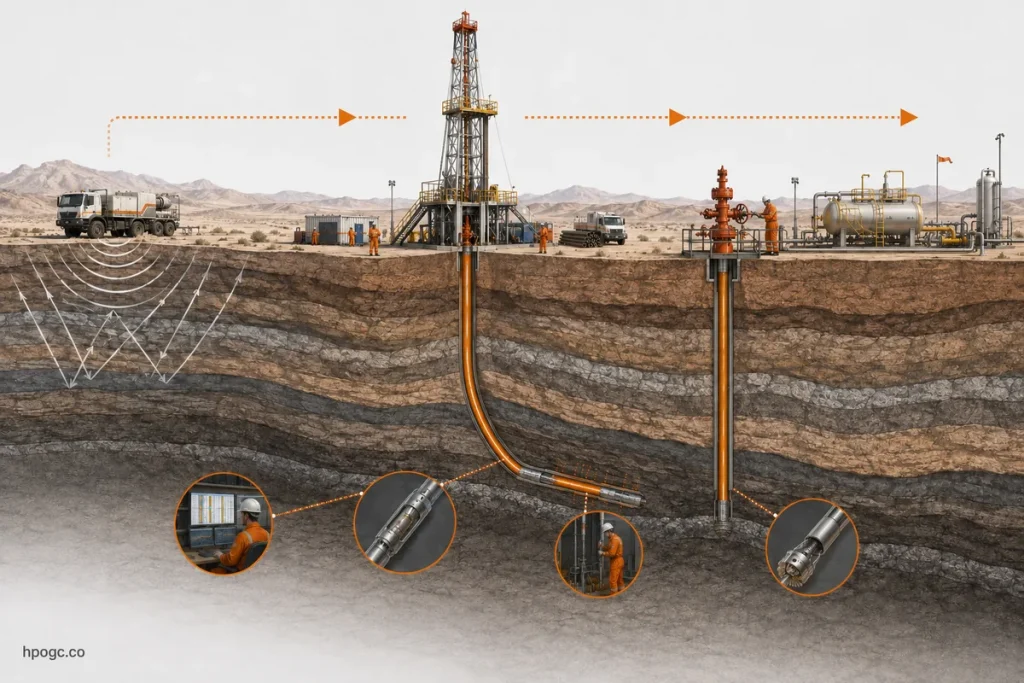
Hamrah Pooshesh Engineering Services Company: A Specialized Downhole Services Player
Hamrah Pooshesh Engineering Services Company, also known as HPOGC, is one of the specialized players in downhole services, directional drilling, and well equipment. According to the company’s official profile, Hamrah Pooshesh has more than 30 years of experience in supplying, manufacturing, and providing services for downhole equipment. The company initially began its activities by obtaining representation from reputable international companies in the field of oil and gas equipment.
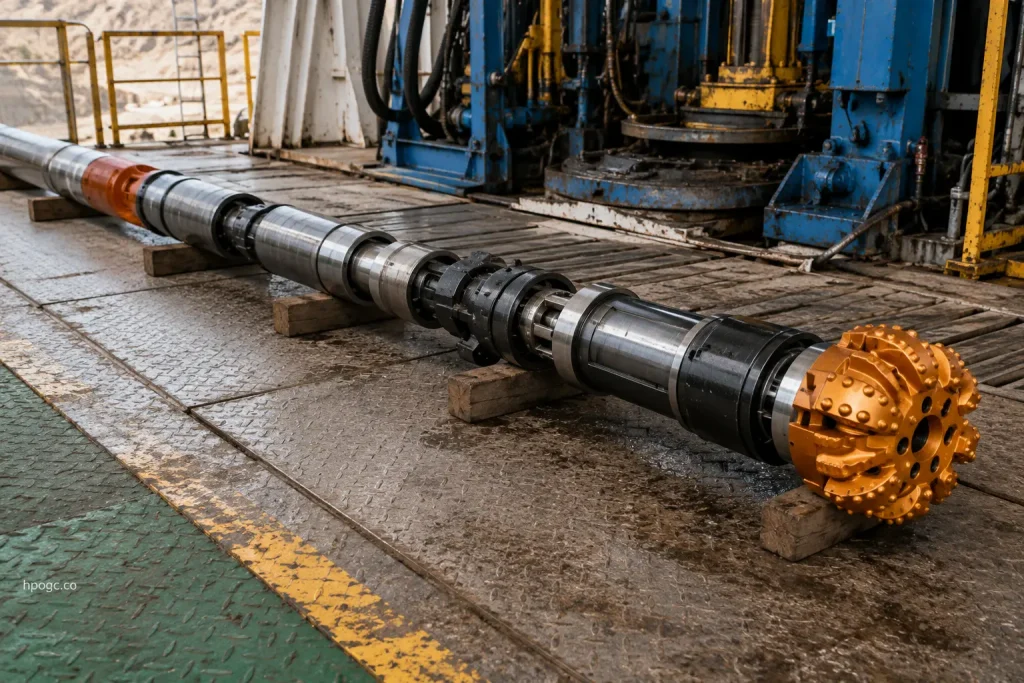
Hamrah Pooshesh’s position in the upstream value chain can be understood alongside companies such as WSI, SeaLand, Petro Kariz Omid Kish, Petro Daniel Kish, and other well services providers. What distinguishes Hamrah Pooshesh from many general contractors is its focus on services close to the wellbore, including directional drilling, MWD/LWD, downhole motors, drilling tools, gyro services, completion equipment, and tools related to well operations.
Directional Drilling and MWD/LWD Services at Hamrah Pooshesh
On its official directional drilling services page, Hamrah Pooshesh refers to services such as well planning and drilling engineering, MWD and LWD, downhole motors, sale and rental of drilling tools, manufacturing of directional drilling equipment, and gyro services.
The company also states that its trained directional drilling experts use downhole motors together with MWD and LWD tools to provide accurate trajectory control, high-quality wellbores, precise well placement, optimized production, and improved recovery.
Why Downhole Services Are Critical for E&P Companies
An E&P company may design the field development plan, but successful execution is not possible without accurate downhole services. Directional drilling helps guide the well path toward the reservoir target. MWD provides real-time information about the well trajectory and drilling conditions, while LWD delivers formation data during drilling.
In other words, services such as directional drilling, MWD/LWD, gyro, completion tools, and downhole equipment turn an engineering plan into an operational reality. This is why companies like Hamrah Pooshesh are technical complements to drilling contractors and E&P companies.
Other Important Players and Complementary Company List
In addition to the better-known companies, several other names are active in Iran’s upstream and oilfield services market. Some have specialized roles, while others are mainly contractors, equipment manufacturers, or project support companies.
These include WSI, SeaLand Engineering and Well Services, Mehran Well Services, Petro Daniel Kish, Petro Gostaran Ofogh, Pars Drilling Fluids, Sarvak Kish, Kan Dana Engineering, Nepta Well Services Kish, Petro Asmari, Petro Offshore Niyam Kish, DCI, MI Services Kish, PETCO, IOEC, Payandan, Maroon Karan, Namvaran, Sazeh, Hirgan Energy, Tasdid, Sadid, Darya Sahel Gas Pasargad, Hana Energy, Mahan Sanat Arya, Petrosina Arya, Farasahel Kish, Sepehr Energy, and Ghadir.
Why Some Companies Are Only Mentioned by Name
In an SEO-focused market overview, it is not necessary to describe every company in detail. Readers are usually looking for a clear understanding of the main players and their place in the value chain. Therefore, better-known companies should receive short explanations, project references, or service descriptions, while lesser-known companies can be included in a complementary list.
This approach keeps the article both comprehensive and readable. It also prevents the content from becoming a long, unfocused directory of company names.
Non-governmental players in Iran’s upstream oil and gas industry should be understood as an ecosystem. On one side of this ecosystem, companies such as Dana Energy, Pasargad Energy Development Company, Persia Oil and Gas Industry Development Company, MAPNA, OIEC, and Sarvak Azar are active in field development, E&P, engineering, and major project execution.
On the other side, companies such as PEDEX, MAPNA Drilling, North Drilling, Global Petrotech Kish, and Petro Kariz Omid Kish are active in drilling and well services. At a more specialized level, companies such as Hamrah Pooshesh, WSI, SeaLand, Mehran Well Services, and Petro Daniel Kish provide downhole services, directional drilling, well completion, and technical well operations.
Ultimately, the real value of these companies becomes clear when an upstream project moves from planning to execution. Field development does not move forward through contracts and planning alone. It requires rigs, downhole tools, reliable data, operational teams, drilling engineering, and accurate well services. For this reason, downhole services companies such as Hamrah Pooshesh are an essential part of Iran’s upstream oil and gas value chain.
What are non-governmental players in the upstream oil and gas industry?
They are companies that operate outside the direct structure of the National Iranian Oil Company and are active in exploration, field development, drilling, well services, downhole equipment, engineering, and upstream project execution. These companies may be private, semi-private, or affiliated with non-state holdings.
What is the difference between an E&P company and a downhole services company?
An E&P company usually works on field development, reservoir management, and production planning. A downhole services company performs specialized wellbore operations such as directional drilling, MWD/LWD, completion, downhole tools, and well intervention.
Which are some of the most important non-governmental upstream companies in Iran?
Important names include Dana Energy, Pasargad Energy Development Company, Pasargad E&P, OIEC, OEOC, KPE, MAPNA Oil and Gas Development Company, PEDEX, Sina Energy Gostar, Global Petrotech Kish, North Drilling, WSI, SeaLand, Petro Kariz Omid Kish, Petro Daniel Kish, and Hamrah Pooshesh.
What role does directional drilling play in oil and gas field development?
Directional drilling allows the drilling team to control the well path, reach the reservoir target more accurately, pass geological obstacles, increase reservoir contact, and reduce operational risk. It is especially important for horizontal wells, deviated wells, and complex reservoirs.
Where does Hamrah Pooshesh fit in the upstream value chain?
Hamrah Pooshesh operates in downhole services, directional drilling, MWD/LWD, well equipment, drilling tools, completion, and services related to well operations. The company acts as a technical complement to drilling contractors and E&P companies.